
Where it all began…
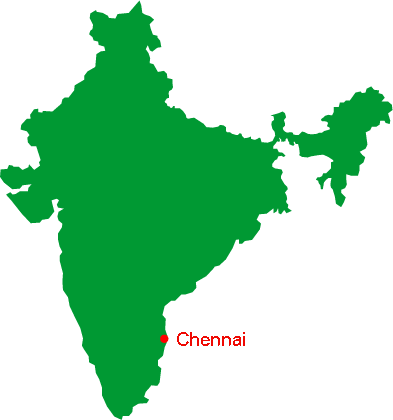
In 2003, Alice Wallther from Hindås, Sweden, travelled to Chennai, India’s fifth largest city. In order to get a better understanding of the area, she arranged to shadow some social workers in slum areas. Alice began giving after-school English lessons to the children in the slum areas and on the street. She was impressed by the children’s enthusiasm to learn, but also concerned by the difficult circumstances preventing them from continuing their schooling.
A classroom would provide protection from the elements and a dedicated space where they could study and do their homework. In order for Alice to finance this project, she produced cards and calendars from photos she had taken during her visit. In 2005, she returned to the slum area in Chennai, built a small classroom and employed its first teacher, the only girl from that slum area who had attended university and knew the children well. In order to ensure accountability and that funds went directly to the project such as wages and land rent, Alice made a formal agreement with a local organsiation that was already based in the area. This organisation also reported regularly on attendance and progress. When she returned to review the project a year later, Alice found that more children were regularly attending school with enthusiasm and a feeling of potential. The idea that this small intervention seemed to have made a big difference to these children motivated Alice and several other people back in Sweden to continue the project and the charity ChennaiSmiles was formed.
Mottukal (2005-2010)
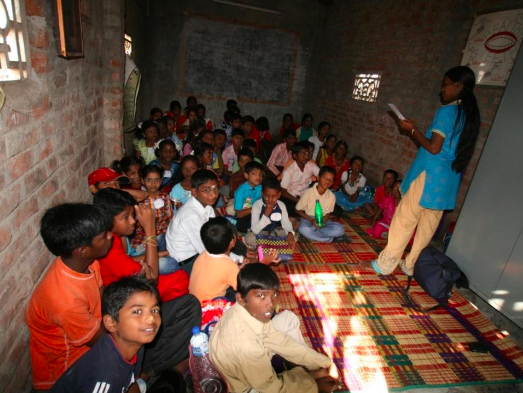
In 2005, a classroom was built in icehouse slum area in Chennai, funded by sales of greeting cards and calendars.
For the first six years, this classroom was used by the local children to do their homework and to get extra tuition by local tutors. This was financed by ChennaiSmiles and administered by a local organisation, Mottukal.
Aid India (2010-2014)
We realised at an early stage that the original tuition centre was a temporary solution. In 2010 we were fortunate to start a collaboration with Aid India, when the centre was shifted to a larger nearby rented building and tuition was run by teachers trained in the Aid India teaching methods.
Since 2014 Aid India has been running this centre using locally sourced funds and we no longer fund Aid India.
Although we are no longer linked financially with Aid India, we continue to be inspired by their enthusiasm and innovation and enjoy receiving updates about the centre. Given our previous sponsorship of Aid India and our continued interest in their inspiring work, we want to give a short synopsis of their efforts and teaching methodology.
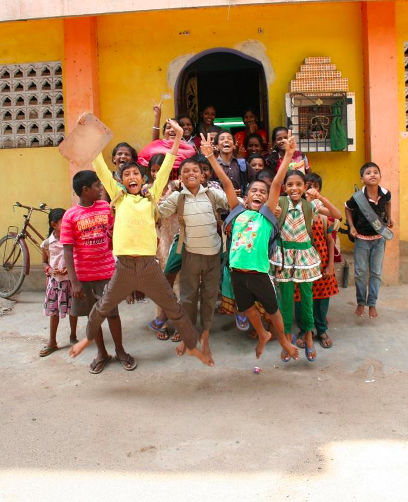
Over the years, Aid India has built up a fantastic team with experience in the field of teaching methodology and development of educational aids. One of their major strengths is their culture of outcome measurement using validated techniques and their own skills charts. This benefits the children by identifying areas of weakness for teachers to focus on, both individually and as a group, and also provides continuous feedback to Aid India for their own development. Observing their teaching methods in practice, it is apparent that the children not only gain important skills in Tamil, English, Maths and Science, but that they also develop a hunger for learning and increase their self-confidence.
In the last few years, the Aid India team has changed their strategy in order to reach a wider need across Tamil Nadu without compromising their vision. Their goal continues to be that all children in Tamil Nadu should have access to quality education and life opportunities. They are running small-scale programs of high quality, primarily their two Eureka schools and learning centers, and also three centers in Chennai, including the one that we were supporting earlier. In addition, they are also working with many local organisations as well as government schools to improve education state-wide. In the Eureka SPARK program, they are working with many non-governmental organisations (NGO) whereby Aid India provide tutor training using Aid India methodology and materials produced by Aid India. This strategy involves twenty-five NGOs working with 550 tutors across Tamil Nadu. The second strategy involves trying to introduce Aid India teaching methods into government schools by seeking to engage both the regional education officers and individual teachers in schools.
Brother Siga Animation Centre (BSAC) (2014-)
In 2014 AID India introduced us to one of their local partner organisations, Brother Siga Animation Centre (BSAC) and BSAC subsequently became our main partner organisation. BSAC is based in a deprived area in North Chennai. They work in local slum areas as well as in nearby rural villages where there is extreme poverty. Their three main focuses are on education, child rights and skill building.
BSAC was founded by S. Shanmugam in 1984 and was inspired by his role model, Brother Sigamany. The latter apparently influenced local youths, including Mr Shanmugam himself, to change their destiny by contributing back to society in some way. BSAC’s tradename Aarvam meaning Interest, Affection, Love was coined by the children themselves.
Education
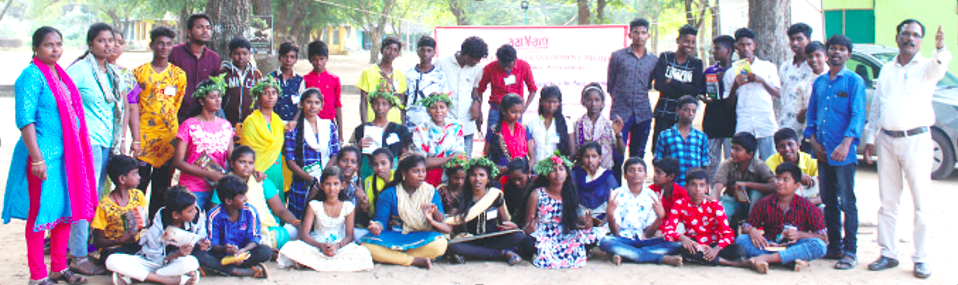
One of the main aims of BSAC is to encourage reading through their reading enhancement scheme and they particularly target children between ages eight and ten, as they noted that this is a crucial age for encouraging ongoing schooling. They run a resource library and also have ‘Book fairies’ going in to six local corporation schools for two hours a day to encourage reading and story-telling. Over the years they have also encouraged story writing and have published several stories by local children. Since they started working in the area, the school drop out rate has reduced significantly from approximately 50% to near none. BSAC currently runs six after-school supplementary education centres in North Chennai slum areas and also a further twelve rural education centres in Gumuripundi near Chennai. They use AID India resources, materials and teaching methodologies. in their supplementary education centers.
Child Rights
BSAC focuses on Child Rights by running child participation groups and giving parent education on important matters including child abuse, child prostitution and the right to education. In response to needs identified through child and youth participation, they have also increased their focus on mental health through several initiatives and collaborations.
Skill building
BSAC supports children and young adults from age eight to twenty years old. Apart from basic education, they offer support in skills development to improve employment opportunities by offering computer training, tailoring and other apprenticeships.
 ChennaiSmiles